


Partners and family
Closeness, daily life, recurring arguments or silence. Make room for a conversation without judging each other.
Love is not only about romance. It is a relationship-coherence space for partners, families, neighbours, colleagues and friends: notice reaction loops, hear one another and choose a small, respectful next step.
Not a compatibility test. Not a future reflection. It is a relationship context map that helps you understand what is happening between you and choose a calmer next step.
A brief note on limits: this is a reflection tool, not therapy, not a diagnosis and not a verdict on your relationship. If there is violence or you feel unsafe, the first step is real human support.
A relationship context layer for reflection, connection, and clearer decisions. Love Coherence Context reveals recurring communication and reaction patterns — triggers, needs, defenses and repair steps. The system does not judge people or define a “correct” relationship.
Relationship coherence means clearer connection across everyday settings. Start with one real interaction; describe your own experience rather than diagnosing someone else.
Closeness, daily life, recurring arguments or silence. Make room for a conversation without judging each other.
Shared space, noise, parking or different habits. Clarify boundaries and agreements without hostile assumptions.
Tasks, feedback, respect and team tension. Separate facts from interpretations and agree on a next step.
Parties, jokes, exclusion or disagreement. Notice when connection weakens and return to respectful dialogue.
Teachers, lecturers and mentors carry a different responsibility from learners. Love helps examine a communication moment; it does not grade a student or label their ability.

After public feedback, a student stops asking questions even though the task is still unclear.
Next stepName the specific learning moment, speak privately and ask what support would help next.
Draft a first sentence →Boundary: Do not enter minors' names or sensitive details into the shared local profile.
Teammates, coaches, creators and volunteers share a goal, but not always a pace or expectations. Coherence means clear roles, respectful feedback and room for everyone to participate.

After a match or rehearsal, one comment becomes an argument about who 'did not try hard enough'.
Next stepSeparate facts from guesses about a person, hear their view and agree on one thing to try next.
Trace the trigger →Boundary: A group agreement must not silence personal boundaries or replace a responsible coach's judgment.
Parents, teenagers, adult children and older relatives may understand help and independence differently. Love helps discuss needs and boundaries while leaving decisions with people.

An offer of help feels like control; care and autonomy collide in the same conversation.
Next stepAsk what help the person wants, what they want to decide for themselves and where a clear agreement is needed.
Choose your own step →Boundary: For health, care or safety matters, this tool does not replace professionals or genuine consent.
Tone is easy to lose in group chats, forums and gaming teams. Before replying, check what you know, what you are only assuming and which boundaries matter.

A short group message is read as an attack, and others join before hearing the context.
Next stepPause public escalation, clarify the meaning and, if appropriate, suggest a calm direct conversation.
Draft a calm reply →Boundary: Harassment or threats call for platform moderation and real-world help, not reflection alone.
The Love Coherence Context layer is for people who want to understand repeating relationship dynamics and move from blame to clearer action.

When the same conflict keeps returning and you want calmer conversation, not another spiral.
When you want to see your triggers, needs and automatic reactions without self-blame.
As a supporting reflection layer to structure conversation before deeper work with people.
When you share a courtyard, building or street and need clear boundaries and agreements.
When workload, tone or feedback creates tension and you want to keep working together respectfully.
When a gathering or conversation leaves distance, misunderstanding or a sense of exclusion.
The system looks for the loop, not the villain: what triggered you, which need stayed unfed, how you tried to protect yourself, and what sentence or action could change direction.
Quick relationship notes stay in this browser's local storage (localStorage) and are available in the full Love app in the same browser. A guest-ID cookie is shared across MetaCore subdomains, so this is not full anonymity. Other users of a shared device may see the notes. Clearing browser data will erase them. View or clear profile → · Privacy and data controls →
Updates from the form. After several saved situations you will see what repeats.
If there is violence, threats or you feel unsafe, this tool is not the answer. Contact a real person: 116 123 or 112.
Everything starts with recognising the loop: what triggers, what it touches, how I react, what stops it, and one small step that depends on me.
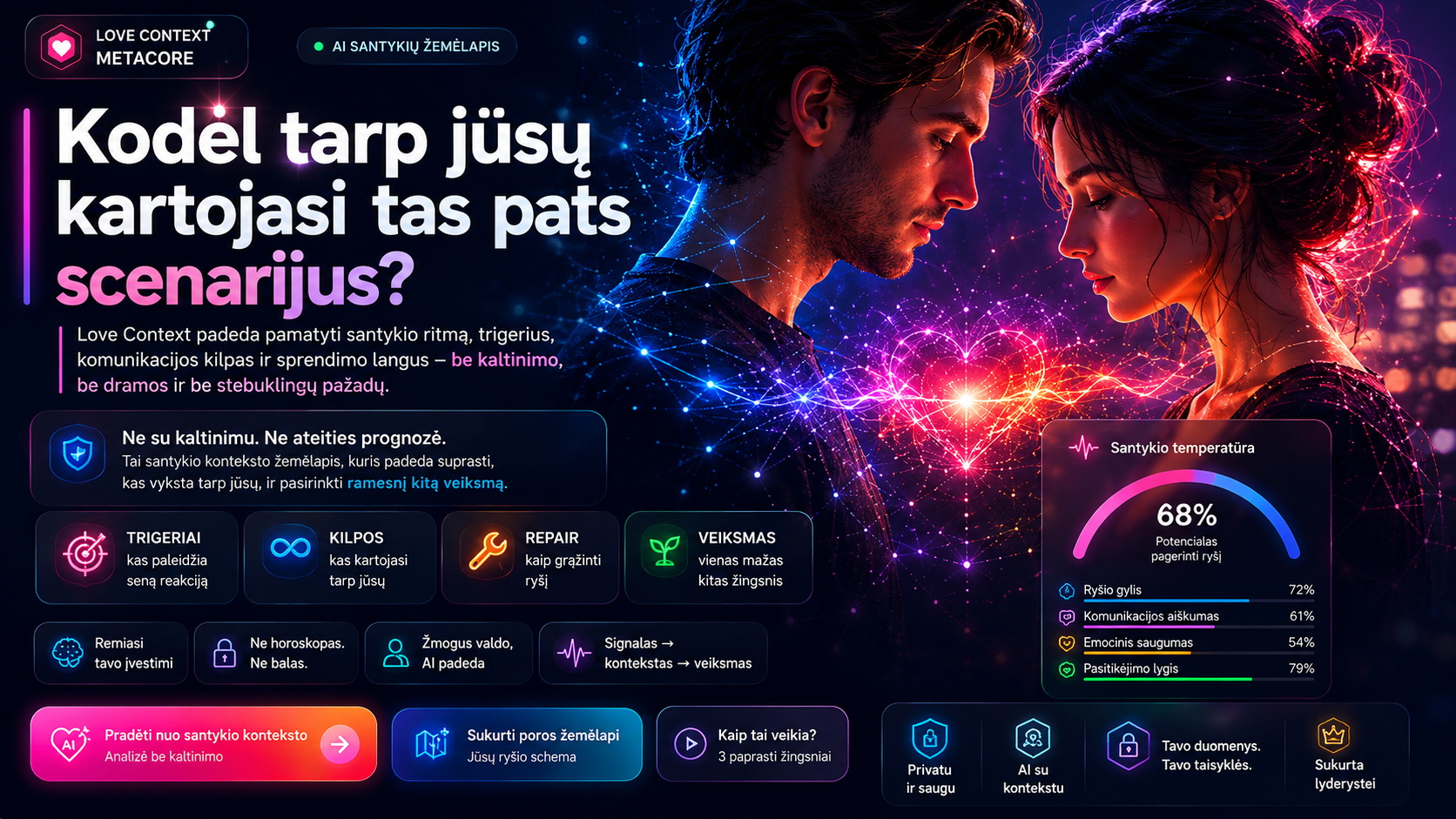
See what starts the spiral, what it touches and what interrupts it.
Open →Situation, feeling, reason and question — without escalating blame.
Open →Cool down, own your part, hear the other and offer one fix.
Open →One small step you control — not a condition or demand on the other.
Open →The system does not just rewrite your words. It looks for the link between what triggers you, what you actually need, how you react and what could interrupt the old loop.
What switched on the reaction: tone, silence, criticism, distance, control?
trigger signalWhat was missing underneath: safety, being heard, closeness, respect?
need under signalHow you tried to protect yourself and what sentence or action could stop the old automatic loop?
reaction → repairWhen you save several situations, Love Coherence Context Engine starts to see what repeats: the same trigger, the same need, the same reaction and the same missed repair point.
That helps you move from “who is wrong?” to: what mechanism do we both repeat without wanting to — and where can we place a smaller, safer step?

If you want, you can later open an additional symbolic perspective. This is not the main Love Coherence Context path, not a relationship reflection and not an authority over your decisions.
Open only as additional perspectiveLove Coherence Context Engine does not say who is wrong. It calculates from your input and history — not from a horoscope. Live reflection updates in the form above.
After several saved situations, “appeared X times” signals show up. Full tools (trigger map, repair, next step) — app_en.html.
This tool does not judge who is right or wrong, does not diagnose a person and does not replace a psychologist, therapist or crisis support. Its goal is to help you safely see a repeating relationship loop, name the need and find one smaller, more conscious next step.
Relationship clarity first, technology second. You can continue with Love tools here. If you need broader AI context, persistence or stronger human AI skills, MetaCore offers separate paths.
Continue with trigger maps, conversation repair, loop profile and the full Love Coherence Context toolkit using the same guest profile.
Continue Love →↗If you want to try MetaCore working logic with ChatGPT, Claude, Cursor or another supported AI provider, this is an optional separate entry.
Try AI Boost →↗For a private persistent workspace beyond this browser’s localStorage — for files, context and longer-running AI work. Love profile data is not automatically moved there.
Explore MetaCloud →↗For people who want to manage AI work better: context, sources, workflow, verification and human decision boundaries.
Explore Operator Boosting →↗Trigger map, conversation repair, loop profile and deeper reflection — the full system opens on the app page with the same guest profile.
Open full version →